Showing posts with label Somers. Show all posts

Thursday, May 16, 2019

A Little bit of Magic

 Early this week I had a Facebook Friend request.  After checking it out and noting the names Somers and Geraghty I quickly accepted.  Shortly there after I got a message from Jacqueline thanking me for accepting the request and that she had seen my blog post on the Somers and Wisconsin and that she was living in Roscommon and would like to connect.

Well here I was in Dublin, planning my trip to Athlone on Thursday....so I boldly said I'd love to connect how about in person.

How did I get so lucky!!!!

Tromaun Cemetery


Not only did I meet a true family and locality historian but I got a wondrous tour of the family townlands and cemeteries.

So never tell me there are no fairies.  It had to be some kind of magic that that request came when it did.  A week later and I would have missed out on the opportunity of a lifetime!

Old Somers House Tromaun

House of Jacqueline's Somers family

Watson House (Quaker style)


Monday, March 5, 2018

Athleague Area

The area around Athleague was the home to the Delmores, Somers and Curleys. The pictures here were taken along the road going through Rahara, Lackan and on to Athleague.

In 1749 Luke Delmore was a cotter(1) in Lackan. He has two children under age 14 and one child over age 14 all Papists.

There are various definitions for cotter/cottier.  The time period and place in Ireland can be relevant.  In this case I believe that cotter meant a peasant renting a small piece of land under a system of renting land to the highest bidder as opposed to one having the use of a cottage and small garden in exchange for labor for the farmer.  However, that is only a guess based on the fact that there are two cotters and four laborers as well as a weaver listed in the townland.  The size of the holding is not listed in this Elphin Census, again there is a disparity in definitions giving the size of cottiers holdings, some saying that they are generally 1 to 1 1/2 acres in size and others saying they might be as much as ten acres.  Nearby townlands also use the term tenant as an occupation, so how that differs is unknown at this point.

In 1830 Luke Dilmar had a 3 acre holding with a partner in Keenagh.  No family information was included in the Tithe Applotments, we do know that Luke had two sons Luke and Francis born 1816 and 1819, but their christening records do not give a townland. This is the right parish. No other Luke D? was found elsewhere so it seems likely he was either living on this land or living in a town big enough that it was not enumerated. The tithe applotments were limited to rural areas.

Somers and Curley's could be found in Tremain. 

Pictures in Dropbox


(1) There are different definitions of Cottier / Cotter Tenure.  One definition states that a cottier is a peasant renting a small piece of land under a system of renting land to the highest bidder. A second definition states that a cottier was one having the use of a cottage and small garden in exchange for labor for the farmer. Different definitions state the size of a holding could be one to one and a half acres, others state the holdings might be as big as ten acres. It is assumed that the definition for Luke in 1749 fits more with the first definition as he is one of two cotters listed in Lacken and there are four men listed as laborers as well as one with no occupation and a weaver.

Monday, September 25, 2017

Picture Milwaukee

Located in southeastern Wisconsin on the shores of Lake Michigan, the city of Milwaukee is the county seat of Milwaukee County.

LOC collections Milwaukee 1879
http://hdl.loc.gov/loc.gmd/g4124m.pm010460
By 1880 it was the 17th largest city in the United States with 115,587 people.  Average life expectancy was 18 years, the result of unwashed inhabitants, unsanitary streets, unsafe foods, and often unchecked spread of disease.

The city was in debt, by 1857 they had lost 1.6 million investing in Rail Roads.  Although they built a reputation for solid conservative banking and fiscal policies in 1880 the debt amounted to $18.69 per individual, a total of $2.2 million for the entire city.

Milwaukee had 231.83 miles of streets.  150 miles were gravel and 25 miles of wood.  Asphalt which was introduced after 1871 still melted in hot weather.  Sidewalks were constructed of plank, flagstone and cement.  Street cleaning was  a problem.  Urine and manure covered the streets.  Cleaning cost the city about $53,000 a year and that did not include snow removal.  Volunteer crews shoveled to create fire lanes.

Dead animal removal cost the city about $850 a year.  The carcasses were taken by private contractors to glue factories.

In 1878 the city began regular collection of garbage and ashes at the cost of $10,000 to the city.  Collections were daily from April 20 - Oct 20 and twice a week the rest of the year. The collections wee taken to dumping grounds beyond city limits.

Liquid household wastes gathered in cesspools, privy vaults, gutters and sewers, causing danger to shallow wells. Licensed scavengers with air-tight carts cleaned out the privies between 11pm and 4 am.  Liquid waste often found its way into lakes and streams.

milwaukee.bmp
LOC Collections - Milwaukee  - Beck & Pauli.1882

The sewers, a systemic plan created by ES Chesbrough, consisted of vitrified earthen ware and cement pipes with manhole covers.  With a capacity for 280,000 people they ran to the Menomonee River and into Lake Michigan.  The reality is the waste backed up into the river rather than spreading through the lake.

Industrial waste and smoke were rampant, but, they were considered signs of progress and not a danger to ones health.

Before 1876 Milwaukee had a monopoly on gas lights.  Customers were charged $2.25 a month and outages and flickering were common.  Commercial enterprises were favored over individual customers.  Downtown, gas-lighters ran from pole to pole to light the street lights. When Edison perfected electric lighting Milwaukee was a quick adopter.

In 1870 the city had 42 police officers, one for every 1700 citizens, causing the mayor to claim that the city was more secure than in any other city on the continent of equal or greater size.  By 1880 the number of officers had increased to 69.  They made $800 a year and had to buy their own uniforms at a cost of about $60.  The chief made $3000 per year.  In 1880 there were 2564 arrests, 3445 lodgers in jail and the entire budget was $76000 for the year.  These were high wages, other cities in Wisconsin paid about $1 a day, but the city need to control their tough waterfront dives!

This was the city where Peter Somers (nephew of Margaret Somers Delmore) became mayor in 1890 and where Johannes Baier(l) settled with his daughter after his son John moved to Minnesota.

Wednesday, February 22, 2017

Luke and Margaret

“Mr. Somers proceeded to Roscommon, a pretty little village where he spent the most of his time in Ireland, his friends and relatives living there.  He found a sort of farmers fair in progress and found considerable amusement in observing the manner in which the rugged old farmers effected their trades: Instead of transacting the business in the presence of witnesses as elsewhere is customary, the two withdrawing to a secluded place, effecting the bargain and relying upon either’s word of honor to abide by its stipulations.  He saw no mirth, no intoxication at this fair, the people evidently being to poor in purse and too fully impressed with the grave prospects of the country to give way to their native exuberance of spirit.  With the exception of a few landowners farm work is accomplished with the crudest implements.  The land in the vicinity of Roscommon is principally owned by Lord Crofton, whose tenants recently demanded of him a reduction of thirty percent in rent, and upon his refusal declined to pay any rent......the trains... were loaded with people bound for new homes in America, soldiers and policemen and at every station occurred scenes of parting between husbands and wives, stalwart sons and aged parents, which could not fail to bring tears to the eyes of perfect strangers.  Everyone who can possibly leave the island is doing so.  The vessel upon which I sailed contained a thousand of these poor emigrants who despite their wretched existence on the little island, yet parted from it with breaking heart......”  

Thus Peter J. Somers described the home of his ancestors in a talk for the Milwaukee Hibernian Society on 22 Jan 1882.[1]

Some thirty five  years earlier Luke and Margaret (Somers) Delmore, tiny daughters in their arms, stood surrounded by relatives as they took one last look at the hometown that they were never to see again.  Surely they did not see the misery of Ireland that day, but only felt the misery of leaving parents and family behind.  Did their fathers come out to see them on their way, or were they each home mourning the departure of yet more of their family?

Margaret, the daughter of Martin Somers and Mary Curley, and Luke, the son of Luke and Sara Delmore, sought to leave famine imposed poverty behind as they departed in Dec 1846 to join Margaret’s brother and his family in Wisconsin.  Making their way on foot, cart and ship, they boarded an old condemned sailing vessel, the Rappahannock, in Liverpool, destination New York Harbor.  

But trouble had not been left behind.  Cholera broke out on board and the ship was not allowed into port.  Surely despair must have engulfed the passengers as day followed day and port after port denied them entry.  Finally, after 16 weeks at sea,  on the 19 of April 1847 Luke, Margaret, and Mary set foot on solid land not in New York but in New Orleans.[2] Sadly, Sara the first born, christened on 25 May 1845 had not survived the journey. [4] 


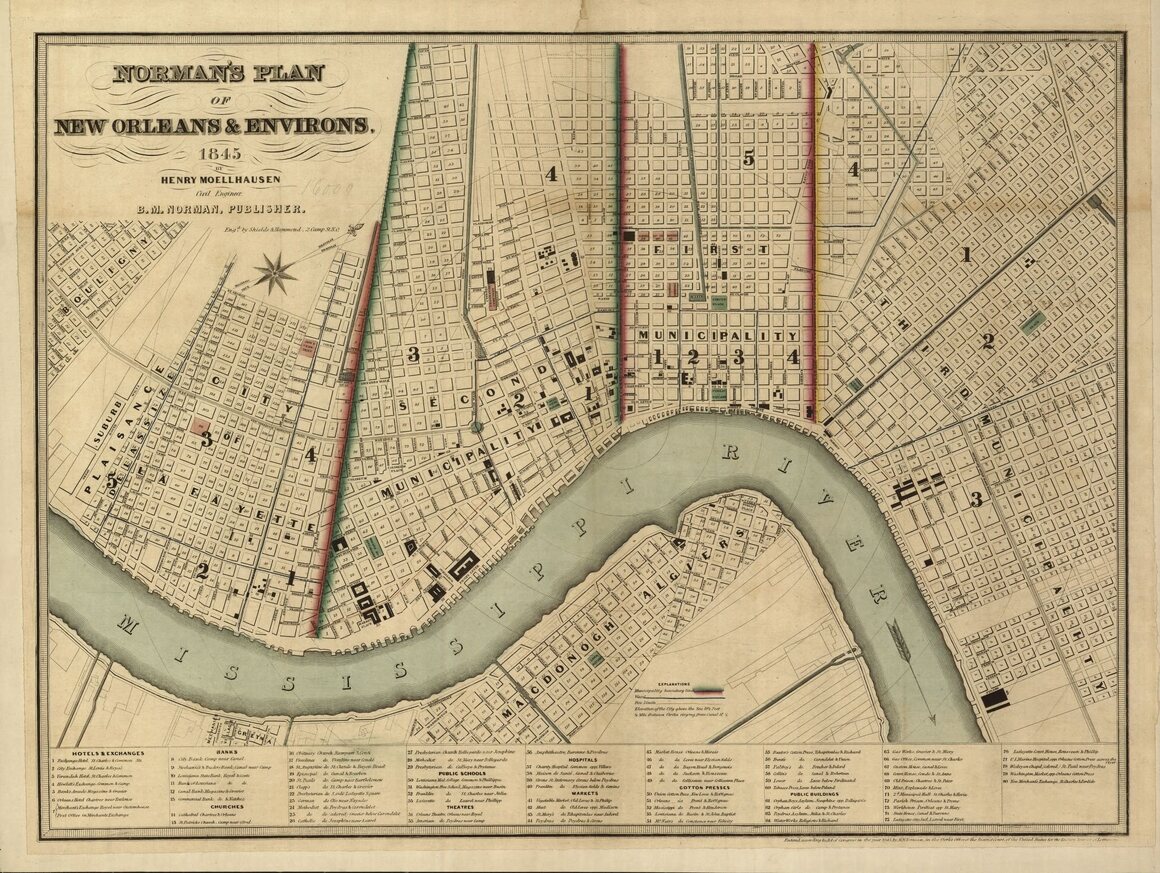
New Orleans in 1845.
Möllhausen, Henry, Benjamin Moore Norman, and Shields & Hammond. 
Norman's plan of New Orleans & environs, 1845. [S.l, 1845] Map. 
Retrieved from the Library of Congress, https://www.loc.gov/item/98687133/
Dolores Young relates the story told as to her by her grandmother Mary Delmore Baier. 

“Luke and Margaret, thankful that they were in America, spent the summer in the Irish section of New Orleans looking for an opportunity to travel north to Wisconsin.  The trip across country was made by covered wagon drawn by oxen. Riding in a covered wagon meant a bone-rattling trip, jammed into a 10'x4' space with other family members, all the household utensils and personal belongings.  They cooked by the roadside on open campfires, traveled through rain and swollen rivers, slept in the wagons or in the open and were in constant fear of Indians.  Fortunately they were not traveling alone.  They joined with friends and family on the northward journey, grateful for the companionship as they fought rain, insects, wind and sickness.” [3]

Certainly Mary was not likely to recall this trip, being just a year old at the time, but just as certainly her parents would have related the details.  Mary would say that no hardship was too hard for her parents, after all they were “In America” and things would get better.

Mary had been christened in Ireland on 1 Jul 1846[4]  In the 1850 census, we find Luke, Margaret, Mary and Sarah, a younger Sarah, in Wisconsin.[5]  The death of their oldest child must have been painful, never spoken of, for all members of the family believed that Mary was the first born.  Only in later years when Luke talked of having thirteen children and only ten could be found was there a clue that at least one had not survived childhood.  

The adventures of Luke and Margaret, the corncob pipe smoking granny, and their large brood of children continue as they settle first in Lemonweir, Juneau Co., Wisconsin and later in Rochester Minnesota, but that’s another tale.


[1]         “A Miserable People - A Milwaukeean’s Impression of affairs in Down trodden Ireland” The Milwaukee Sentinel 22 Jan 1882, Milwaukee, Wisconsin
[2]        New Orleans, Louisiana, Passenger Lists of Vessels Arriving in New Orleans, LA, 1820-1902.  Micropublication M259., roll 26, National Archives, Washington D.C. Luke Delmore 25, M Ireland, Mary Delmore 25 F Ireland, Sally Delmore 2 F Ireland, Mary Delmore 6mo F Ireland. Note: next to Luke's name it says deceased.  As he definitely survived the journey and Sarah did not arrive in Wisconsin, we assume that she passed away on board.  It is possible that she survived the journey and died in New Orleans, but there is no evidence to suggest that.
[3]        Young, Dolores, Family Memories, 1988 Self Published St. Paul Minnesota
[4]       Skelly, Mary, Delmore Family Research, 2001 County Roscommon Heritage & Genealogical Centre, Church Street, Stokestown, Co. Roscommon, Ireland   T43-96\37 Athleague Parish Sponsors Peter and Catherine Summers
[5]      1850 United States Census Population Schedule, National Archives Micropublication M432 , Washington DC, Roll 1009 page 463  Menomenee, Waukesha, Wisconsin 

Wednesday, May 11, 2016

The Bog

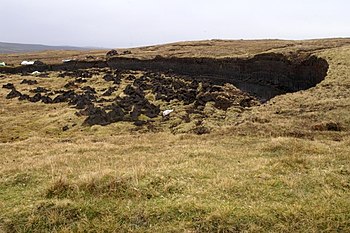
Blanket Bog - Wikipedia
In Ireland 17% of the land surface is bog, only Canada and Finland have a higher percentage. Bog is a derivation of the Irish word bogarch, which means soft - in this case "soft land." Many of the lease holdings in rural Ireland included a piece of bog, where the resident could cut and dry their fuel. 
It takes one thousand years to grow just a one meter depth of bog. The peat itself consists of 95% water, the remainder made up of rotted vegetation, pollen, dust and the like. In Ireland, it has traditionally been cut and dried and burned in the fireplace as turf.
Ireland Peat Cutting - Public Domain Images
Our Irish ancestors depended on this fuel to survive. 
The Tithe Applotment records of Listowel Parish in County Kerry show that 113 acres of Thomas English's 235 acre holding were bog.  Interestingly this is not recorded in Griffith's although other holdings in the area did say they included bog land.
Carrownaclea -   Islandeady Field Book - 1841
The 1841 Carrownaclea (Mayo) Field Book shows bog lands.  Carrownaclea is interesting in that in both the Tithe Applotments and Griffith's Valuations the entire townland is linked together, no one appears to have a specific piece of land, yet in the field book it is divided into 8 holdings. Perhaps the residents (including the Geraghtys) were all laborers in the employ of Capt. Wyndham who owned the land in fee.
Derrycoosh - Islandeady Field Book 1841
Like Carrownaclea, Griffith's Valuations for Derrycoosh (Mayo)  does not give the acreage of holdings, however combining it with the 1841 Field book, we find the following description for the land held by Patrick Walsh (son of John).
In Roscommon, the Delmore's lived in town and would most likely have bought their turf as needed.  Martin Somer's held 15 acres in Scregg.  About 1/2 was considered arable the other half did not appear to be bog but rather too gravelly with shallow topsoil.  Other areas of the townland did include some bog.
This is just a sample of what the land of our ancestors was like.  If they did not have bog land in their possession, they might have been allowed a share from other land of the landlord, they might have traded other commodities for turf, they might have bought turf when they had money, and worst case, they might have gone without heat and the ability to cook in hard times.